This document supports
Account of a Declaration, a
service of the point.B Library.
Copyright ©1996-2003 by LeftJustified
Publiks. All Rights reserved.
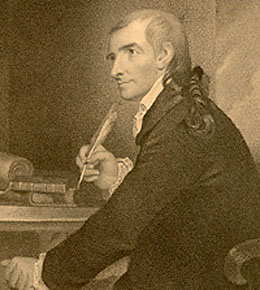
- William Floyd ·17341821·
- Representing New York at the Continental Congress
Born:
December 17, 1734 in: Brookhaven, N.Y.
Work: Soldier; Member
of Continental Congress of 1774-76; Member of Congress, 1789-91; State Senator,
New York, 1808.
Died: August 4, 1821.
William Floyd was born on
Long Island on December 17, 1734. His family had emigrated to America in 1654
and by the time of his birth were well established and wealthy. Though he might
have received the best education, his father died when he was in his teens, and
William was required to take over the operations of the family farm. He was a
member of the Suffolk County Militia in the early conflict with Britain. He
attained the rank of major general, though at this late date he spent most of
his time in the Continental Congress. In 1774 he was chosen to represent New
York in the first Continental Congress. He served there through 1776, while his
property was destroyed in the Revolutionary War. He acquired land on the banks
of the Mohawk river after the war though it would be a few more years till he
would retire there. In 1789 he was elected to congress under the new
constitution. He served there, acting several times as a presidential elector,
until he returned to his native state in 1791. He was called to the service of
his state as a Senator in 1803. After serving his term he retired to his true
passion, farming. He died in 1821. -Sources:
PFG,
Signers.
©1996-2003 by
LeftJustified Publiks. All rights reserved.

- Benjamin Franklin ·17061790·
- Representing Pennsylvania at the Continental Congress
Born: January 17, 1706 in: Boston, Ma.
Education:
Self-taught, apprenticed as a printer. Honorary Doctor of Laws, Universities of
St. Andrews and Oxford.
Work: Printer, Publisher, Scientist. Clerk
of the Pennsylvania Assembly, 1736; Founded the Library Company of
Philadelphia, 1731; Postmaster of Philadelphia, 1737-1753; Member of
Pennsylvania Assembly, 1751-1764; Deputy Postmaster general of the British
colonies in America, 1753; Founded Academy of Sciences of Philadelphia, 1753;
Agent to Europe for Pennsylvania, 1757-1762, for Pennsylvania, Georgia, New
Jersey, Massachusetts, 1764-1775; Elected to Continental Congress, 1775;
Testified before Parliament concerning the Stamp Act, 1776; Postmaster General
of the united colonies, 1775; Commissioner to the French Court, 1776; Minister
plenipotentiary to the French Court, 1779; Negotiator in and Member of the
Treaties with Gr.-Britain, 1781-1783; Member of the Supreme Executive Council
of Pennsylvania, President of Pennsylvania Society for the Abolition of
Slavery, 1785; Senior member of the Constitutional Convention, 1785.
Died: April 17, 1790.
Benjamin Franklin, born in Boston,
Massachusetts, on January 17, 1706, may by his life alone be the most profound
statement of what an American strives to be.
With no formal education beyond the age of ten years, Franklin was celebrated
throughout Europe, welcomed in any Royal Court, sought out by every prestigious
society. Indeed, when the reputations of George Washington and Thomas Jefferson
had yet to be sorted out, Franklin was worshipped wherever his name was
known.
He attended grammar school at age eight, but was put to work at ten.
He apprenticed as a printer to his brother James, who printed the New England
Courant, at age twelve, and published his first article there, anonymously, in
1721. Young Benjamin was an avid reader, inquisitive and skeptical. Through his
satirical articles, he poked fun at the people of Boston & soon wore out
his welcome, both with his brother and with the city. He ran away to New York
and then on to Philadelphia at the age of sixteen, looking for work as a
printer. He managed a commission to Europe for the purpose of buying supplies
to establish a new printing house in Philadelphia, but found himself abandoned
when he stepped off ship. Through hard work and frugality he bought his fare
back to Philadelphia in 1732 and set up shop as a printer. He was appointed
clerk of the Pennsylvania Assembly in 1736, and as Postmaster the following
year. In 1741 he began publishing Poor Richard's Almanac, a very popular &
influential magazine. He was elected to the Pennsylvania Assembly in 1751 and
served as an agent for Pennsylvania (and ultimately for three other colonies)
to England, France, and several other European powers. He was elected to the
Continental Congress in 1775, where he played a crucial role in the rebellion
against Gr. Britain, including service to Jefferson in editing the Declaration
of Independence. Franklin, who was by this time independently wealthy and
retired from publishing, continued to serve an important role in government
both local and national. He was the United States first Postmaster General,
Minister to the French Court, Treaty agent and signer to the peace with Gr.
Britain, Celebrated Member of the Constitutional convention (See Work, above).
Benjamin Franklin: Businessman, Writer, Publisher, Scientist, Diplomat,
Legislator, and Social activist, was one of the earliest and strongest
advocates for the abolition of Slavery, and for the protection of the rights of
American aboriginal peoples. He died on the 17th of April in 1790. On that day
he was still one of the most celebrated characters in America. So should he
always be. -Sources:
PFG,
EA.
©1996-2003 by
LeftJustified Publiks. All rights reserved.

- George III ·17321792·
- King of Great Britain from 1760 to 1820
Born: June 4,
1738
Work: Ascended the throne in 1760 during the Seven Years' War.
Concluded the Seven Years' War (Treaty of Paris.) Married Charlotte Sophia of
Mecklenburg-Strelitz, September 8, 1761. Prosecuted the American War of
Independence, 1776. Prosecuted various war fronts with Revolutionary France,
Napoleon.
Died: January 29, 1820.
George III was one of the
longest reigning British Monarchs. He oversaw the conquest of an empire in the
Seven Years' War, and the loss of the American Colonies in the War of
Independence. The British Empire was the leading model of Industrial and
economic development in an era when the whole world was to be mapped and
conquered. The face of Europe changed dramatically, as Britain and France
struggled for domination. Britain emerged from that struggle as the world's
leading power, but it was a nation faced with a fragile governmental structure
and deep social strife.
The King was poorly suited for the demands
presented by the age. It was widely know that his intellectual abilities were
limited. A long chain of ineffective appointments to parliament and an
over-dependence on people whom he merely found unthreatening, resulted in
terrible instability in policy both at home and abroad. Tom Paine pointed out,
tellingly, in his treatise Common Sense, that a major failure of Monarchy was
the specter of the people presented with "an ass for a lion" in the person of
the King. Finally, George apparently suffered from a hereditary disease that
rendered him practically insane for several long intervals, and then ultimately
lasted until his death in 1820. -Sources:
FRR.
©1996-2003 by
LeftJustified Publiks. All rights reserved.

- Elbridge Gerry ·17441814·
- Representing Massachusetts at the Continental Congress
Born: Jul. 17, 1744 in: Marblehead, Mass.
Education:
Graduate of Harvard College (Merchant)
Work: Member, General Court
of Massachusetts, 1772; Elected to Massachusetts Legislature, 1773; Provincial
Congress, 1774; Continental Congress, 1776-81, 1783-85; Envoy to France, 1797;
Governor of Massachusetts, 1810, 1811; Vice President of the United States
(with Madison), 1812
Died: November 23, 1814.
Elbridge
Gerry was born in Marblehead, Massachusetts, on July 17, 1744. He studied at
Harvard to be a merchant, graduating in 1762. He was elected to the
Massachusetts Legislature in 1773 and was selected to attend the Provincial
Congress in 1774. He was then appointed to the Continental Congress, were he
was engaged in committee work on commercial and naval concerns. He attended the
Constitutional Convention in 1798 but was opposed to the new Federal
Constitution, refusing to sign it. He was elected to the first two Congresses
from Massachusetts and, in 1797, was one of several envoys sent to France. He
was elected governor of Massachusetts in 1810 and 1811. He was much criticized
for redistricting the state to the advantage of his own party
(Democratic-Republican). That incident was the source of the term
gerrymandering. In 1837 he was elected Vice President of the United States. He
died in office, on November 23, 1814, at the age of seventy. -Sources: PFG.
©1996-2003 by
LeftJustified Publiks. All rights reserved.

- Button Gwinnett ·17351777·
- Representing Georgia at the Continental Congress
Born:
circa 1732-1735 in: Down Hatherly, England
Education:
Mercantile.
Work: Commander of Georgia's Continental Battalion,
Elected to Continental Congress, 1776; President of the Georgia Council of
Safety, 1777.
Died: May 19, 1777.
Button Gwinnett was born
in England around 1735. He came to America, residing briefly in Charleston, and
in 1765 acquired a large tract of land in Georgia. Gwinnett enjoyed little
success in farming or business, but found a footing in the revolutionary
politics of his adopted colony. He was engaged in a long-standing political
rivalry with Lachlan McIntosh, a soldier and leader who would attain highest
rank in the Georgia militia and in state politics. Gwinnett was nonetheless a
respected figure. In 1776 he was appointed commander of Georgia's continental
militia (a post that he was forced to decline, owing to political faction), and
also elected to attend the Continental Congress. Quite soon after he signed the
Declaration, he returned home, where he hoped to gain appointment, once again,
to the leadership of the Georgia militia. The appointment went instead to his
rival. Gwinnett served in the Georgia legislature where he was involved in
drafting a constitution for the new state, but also in strenuous efforts to
destroy the office of McIntosh. The legislature adjourned in February of 1777
and handed control over the Council of Safety. Gwinnett succeeded Archibald
Bulloch as president of the council soon afterward. He then lead an abortive
attempt to invade Florida, in order to secure Georgia's southern border. That
adventure was thwarted by Lachlan McIntosh and his brother George, and Gwinnett
was charged with malfeasance. He was cleared of wrongdoing as he ran an
unsuccessful campaign for Governor. Soon afterward, his honor challenged in
public by McIntosh, he offered a duel. They met outside of Savanna on May 16,
1777, where both were wounded. McIntosh ultimately survived, Button Gwinnett
died three days later at the age of forty six. -Sources:
PFG,
Prof.
©1996-2003 by
LeftJustified Publiks. All rights reserved.

- Lyman Hall ·17241790·
- Representing Georgia at the Continental Congress
Born:
April 12, 1724 in: Wallingford, Conn.
Education: Graduated
Yale College, (Physician.)
Work: Elected to Continental Congress,
1775; Delegate to the Georgia House of Assembly, Elected Governor of Georgia,
1783; Judge, 1785.
Died: October 19, 1790.
Lyman Hall was
born in Connecticut in 1724. He studied medicine at Yale College, graduated in
1756 and went to Charleston, South Carolina, shortly after to establish a
medical practice. He bought land in Georgia in 1760 and established a
plantation there, while continuing to practice medicine. Two years later he
returned to South Carolina, still as a physician. In 1774, by this time
partisan in revolutionary politics, he again came to Georgia and earned the
unflattering attention of the Royal Governor, James Wright. He also secured
election to the Continental Congress, were he was involved in provisioning food
and medicine for the Revolutionary Armies. He was reelected to congress through
1780 but retired to his adopted state in 1777 when state matters, including the
situation of his longtime friend Button Gwinnett, demanded his attention. A
short time later, the war reached Savannah. Hall's property was burned and he
stood accused of high treason. He fled to Charleston, which was also overtaken
by the British. He then fled to Connecticut, some say, where he was harbored by
family.
He returned to Georgia in 1782, to reclaim his lands, was elected
to the House of Assembly in 1783 and then elevated to the office of the
Governor. After a single year as Governor, he served one more year in the
Assembly, then a year as judge. He then returned to private life & was
involved in the continued development of agriculture in the state. Hall died in
1790 at the age of 74. -Sources:
PFG,
Prof.
©1996-2003 by
LeftJustified Publiks. All rights reserved.

- John Hancock ·17371793·
- Representing Massachusetts at the Continental Congress
Born: January 12, 1737 in: Braintree (Quincy), Mass.
Education: Graduated Harvard College (Merchant.)
Work:
Elected to the Boston Assembly, 1766; Delegate to, and President of, the
Provincial Congress of Massachusetts, circa 1773; Elected to Continental
Congress, 1774; Elected President of the Continental Congress, 1775; Member of
Massachusetts state Constitutional Convention, elected Governor of
Massachusetts, through 1793.
Died: October 8, 1793.
The
signature of John Hancock on the Declaration of Independence is the most
flamboyant and easily recognizable of all. It is perhaps no surprise that the
story of his part in the revolution is equally engaging. Few figures were more
well known or more popular than John Hancock.
He played an instrumental role, sometimes
by accident, and other times by design, in coaxing the American Revolution into
being. Born in Braintree, Massachusetts in 1737, he was orphaned as a child,
and adopted by a wealthy merchant Uncle who was childless. Hancock attended
Harvard College for a business education and graduated at the age of 17. He
apprenticed to his Uncle as a clerk and proved so honest and capable that, in
1760, he was sent on a business mission to England. There he witnessed the
coronation of George III and engaged some of the leading businessmen of London.
In 1763, his uncle died and John Hancock inherited what was said to be the
greatest body of wealth in New England. This placed him in a society of men who
consisted mainly of loyalists, suspected by the working population because of
their great affluence and social power. Hancock; however, soon became very
involved in revolutionary politics & his sentiments were, early on &
clearly, for independence from Gr. Britain. He was in company with the Adams'
and other prominent leaders in the republican movement in New England. He was
elected to the Boston Assembly in 1766, and was a member of the Stamp Act
Congress. In 1768 his sloop Liberty was impounded by customs officials at
Boston Harbor, on a charge of running contraband goods. A large group of
private citizens stormed the customs post, burned the government boat, and beat
the officers, causing them to seek refuge on a ship off shore. Soon afterward,
Hancock abetted the Boston Tea Party. The following year he delivered a public
address to a large crown in Boston, commemorating the Boston Massacre. In 1774,
he was elected to the Provincial Congress of Massachusetts and simultaneously
to the Continental Congress. When Peyton Randolph resigned in 1776, Hancock
assumed the position of President. He retired in 1777 due to problems with
gout, but continued public service in his native state by participating in the
formation of its constitution. He was then elected to the Governorship of the
state where he served for five years, declined reelection, and was again
elected in 1787. He served in that office until his death in 1793. The dignity
and character of John Hancock, celebrated by friend and enemy alike, did not
suffer for his love of public attention. He was a populist in every sense, who
held great confidence in the ability of the common man. He also displayed a
pronounced contempt for unreasoned authority. A decree had been delivered form
England in early 1776 offering a large reward for the capture of several
leading figures. Hancock was one of them. On signing the Declaration he
commented, "The British ministry can read that name without spectacles; let
them double their reward." -Sources:
PFG,
EA.
©1996-2003 by
LeftJustified Publiks. All rights reserved.

- Benjamin Harrison ·17261791·
- Representing Virginia at the Continental Congress
Born:
April 5, 1726 in: Berkeley, Va.
Education: Attended William
and Mary College (Farmer, Politician)
Work: Elected to Virginia
House of Burgesses, 1764; Member of the Continental Congress, 1774-77;
Reelected to House of Burgesses, 1777, Selected as Speaker, 1778; Elected
Governor of Virginia, 1782-84, 1791. Died: April 24, 1791.
Benjamin
Harrison was born in Berkeley Virginia in 1726. He attended William and Mary
College in Williamsburg, but was unable to complete his studies due to the
sudden death of his father and two sisters in a lightening strike. He was
elected to the House of Burgesses at the age of 38. In 1764, when the House
defied the Royal Governor & passed the Stamp Act Resolutions, the Governor
tried to bribe Harrison with an appointment to the executive council. He
refused the appointment and instead declared a devotion to republican
principles. Elected to the Continental Congress in 1774, he was one of a party
of representatives who, the following year, attended General Washington in
Cambridge to plan the future of the American Army.
In 1777 he returned to
Virginia to a seat in the House of Burgesses and also to serve as a lieutenant
in his county militia. He was chosen Speaker of the House in 1778, and elected
Governor of the State of Virginia in 1782. He retired from the Governor's
office after five years service. Harrison suffered with gout during his later
years. He died in 1791 at the age of 65.
His son, William Henry Harrison,
was elected ninth President of the United States.-Sources:
PFG,
EA.
©1996-2003 by
LeftJustified Publiks. All rights reserved.

- John Hart ·17111779·
- Representing New Jersey at the Continental Congress
Born:
1713 in: Hopewell, New Jersey.
Education: (Farmer)
Work: Member of the New Jersey Assembly, 1761-1771; Served on the
Committee of Safety, Committee of Correspondence, 1775; Judge of the Court of
Common Pleas, Member of Provincial Assembly 1775; Elected to the Continental
Congress, 1776.
Died: May 11, 1779.
John Hart was a New
Jersey farmer. His exact date of birth is not known. His father had moved from
Connecticut to a farm near Hopewell New Jersey. He helped to build, and later
inherited, that very successful farm and was a leading member of his community.
His first public service was a justice of the peace. In 1761 he was elected the
New Jersey Assembly, there annually reelected until the assembly was dissolved
in 1771. In 1775 he was appointed to the local Committee of Safety, the
Committee of Correspondence, and a judge to the Court of Common Pleas. He was
elected to the newly formed Provincial Congress of New Jersey in 1776, and sent
as a delegate for New Jersey to the Continental Congress that year. Hart's
property was looted in the course of the war. His Wife died on Oct 8th, 1776.
When the area was overrun by the British in November of that year, he was
forced to hide for a time. He was enguaged in public service throughout the
war, twice reelected to the Congress and also serving the Commitee of Safety
and as Speaker of the New Jersey assembly. On June 22nd 1778 he invited the
American army to encamp on his farm. Washington had lunch with him, then had
his famous Council of War at the nearby Hunt House. Twelve thousand men camped
on his fields-during the growing season. After resting and preparing for battle
the troops left on the 24th. On Tuesday, May 11th 1779, he died at the age of
66. -Sources:
Hammond,
PFG,
Signers.
©1996-2003 by
LeftJustified Publiks. All rights reserved.

- Patrick Henry ·17361799·
- Virginia House of Burgesses
Born: May 29, 1736 in:
Hanover County, Virginia.
Education: (Lawyer, Politician)
Work: Elected to Virginia House of Burgesses, 1765; Admitted to the Bar
of the General Court in Virginia, 1769; Elected to the Continental Congress,
1774; Virginia Militia Leader, 1775; Governor of Virginia, 1776-1778, 1784.
Died: June 6, 1799.
"Radical," is a title that few men can wear
with ease. The name Patrick Henry, during the revolution and for some time
after, was synonymous with that word in the minds of colonists and Empire
alike. Henry's reputation as a
passionate and fiery orator exceeded even that of Samuel Adams.
His Stamp Act
Resolutions were, arguably, the first shot fired in the Revolutionary
War.
Patrick Henry's personality was a curious antidote to the stern honor
of Washington, the refined logic of Jefferson, and the well-tempered industry
of Franklin. Young Henry was an idler and by many accounts a derelict; though
everyone knew he was bright, he simply would not lift a finger except to his
own pleasure. By the age of 10, his family knew that he would not be a farmer,
and tried instead to train him toward academe. He would not apply himself to
studies either. At age 21 his father set him up in a business that he
bankrupted shortly thereafter. Finally the general public disgust in Hanover
and pressure from his young family (he had married at the age of eighteen)
caused him to study for six weeks and take the bar exam, which he passed, and
begin work as a lawyer.
In 1764 he moved to Louisa county, Virginia, where,
as a lawyer, he argued in defense of broad voting rights (suffrage) before the
House of Burgesses. The following year he was elected to the House and soon
became its leading radical member. It was that year that he proposed the
Virginia Stamp
Act Resolutions. Few members of the Burgesses, as aristocratic a group of
legislators as existed in the colonies, would argue openly for defiance of Gr.
Britain. Henry argued with remarkable eloquence and fervor in favor of the five
acts, which by most accounts amounted to a treason against the mother country.
In 1774 he represented Virginia in the First Continental Congress where he
continued in the role of firebrand. At the outbreak of the revolution, he
returned to his native state and lead militia in defense of Virginia's
gunpowder store, when the royal Governor spirited it aboard a British ship.
Henry forced the Governor Lord Dunmore to pay for the power at fair price.
In 1776, Henry was elected Governor of Virginia. He was re-elected for three
terms and then succeeded by Thomas Jefferson. He was again elected to the
office in 1784. Patrick Henry was a strong critic of the constitution proposed
in 1787. He was in favor of the strongest possible government for the
individual states, and a weak federal government. He was also very critical of
the fact that the convention was conducted in secret.
President Washington
appointed him Secretary of State in 1795, but Henry declined the office. In
1799, President Adams appointed him envoy to France, but failing health
required him to decline this office too. He died on the sixth of June, 1799 at
the age of sixty-two. -Sources:
EA.
©1996-2003 by
LeftJustified Publiks. All rights reserved.

- Joseph Hewes ·17301779·
- Representing North Carolina at the Continental Congress
Born: January 23, 1730 in: Princeton, New Jersey
Education: Graduated Princeton College (Merchant.)
Work:
Member of the Colonial Assembly of North Carolina, 1766-75. Member of the
Committee of Correspondence, member of new Provincial Assembly, 1775; Elected
to Continental Congress, 1774-79, Defacto first Secretary of the Navy.
Died: November 10, 1779.
Joseph Hewes was born in Princeton,
New Jersey and attended Princeton College. He established a shipping business
in Wilmington, North Carolina in 1760 and, by the time of the revolution, had
amassed a fortune. He elected to the Provincial Assembly in 1766 and served
there until it was dissolved by the royal governor in 1775. He was appointed to
the Committee of Correspondence, elected to the Provincial Legislature, and
sent along to the Continental Congress in 1775. Hewes was known as a tireless
worker in committee and the leading expert on maritime concerns. In 1776 he
sighed the Declaration of Independence and placed his ships at the service of
the Continental Armed Forces. He served the Congress as the Secretary of the
Naval Affairs Committee until 1779, when he fell ill. He died at age fifty.
-Sources: PFG,
Signers.
©1996-2003 by
LeftJustified Publiks. All rights reserved.

- Thomas Heyward Jr. ·17461809·
- Representing South Carolina at the Continental Congress
Born: July 28, 1746 in: St. Lukes Parish, South Carolina
Education: Private classical education, Law studies in America and
England (Lawyer.)
Work: Elected to the Continental Congress,
1775-1778; Judge, 1783-1798.
Died: March 6, 1809.
Thomas
Heyward, Jr. was born in South Carolina in 1746. He received a classical
education at home and continued in legal studies, which he completed in
England. In 1775 he was elected to the Continental Congress, where he signed
the Declaration of Independence. In 1778 he returned to South Carolina to serve
as a Judge. He was taken prisoner by the British while in command of a Militia
force during the siege of Charleston. He resumed his Judgeship following the
war, & retired in 1798. He died in March of 1809 at age sixty four.
-Sources: PFG.
©1996-2003 by
LeftJustified Publiks. All rights reserved.

- William Hooper ·17421790·
- Representing North Carolina at the Continental Congress
Born: June 28, 1742 in: Boston, Massachusetts
Education: Harvard College (Lawyer.)
Work: Elected to General
Assembly of North Carolina, 1773; Member of Continental Congress, 1774-1776;
Judge of the Federal Court; 1786.
Died: October 14, 1790.
William Hooper was born in Boston Massachusetts in 1742. He graduated from
Harvard College in 1760, continued his studies in the law, and settled in
Wilmington, North Carolina in 1767. In 1773 he represented Wilmington in the
General Assembly of North Carolina. He attended the Continental Congress in
1774. He resigned from the Congress in 1776 & returned home. In 1789 he was
appointed to the Federal Bench, but a year later he retired due to failing
health. He died in October of 1790. -Sources:
PFG.
©1996-2003 by
LeftJustified Publiks. All rights reserved.

- Stephen Hopkins ·17071785·
- Representing Rhode Island at the Continental Congress
Born: March 7, 1707 in: Providence, R.I.
Education:
(Lawyer, Educator)
Work: Speaker of the Rhode Island Assembly,
(circa 1750-2); Delegate to the Albany Convention, 1754; Member of the
Continental Congress, 1774-78; Member of Rhode Island Legislature.
Died: July 13, 1785.
Stephen Hopkins was born in Scituate (then
a part of Providence), Rhode Island, on the seventh of March, 1707. He was
apparently self-educated. He was a member and speaker of the Rhode Island
Assembly, and in 1754 was a delegate to the Albany convention in New York were
he considered Franklin's early plan of Union. Hopkins spoke out against British
tyranny long before the revolutionary period. He attended the first Continental
Congress in 1774, and was a party to the Declaration of Independence in 1776.
He left that congress in 1778 and returned to his native state to serve in its
Legislature. He died on the nineteenth of July, 1785 at the age of seventy
eight. -Sources:
PFG.
©1996-2003 by
LeftJustified Publiks. All rights reserved.

- Francis Hopkinson ·17371791·
- Representing New Jersey at the Continental Congress
Born:
September 21, 1737 in: Philadelphia, Pennsylvania
Education:
Graduate of the College of Philadelphia (Lawyer, Judge, Author)
Work: Delegate to the Continental Congress, 1776; Judge of admiralty for
Pennsylvania, 1780; Appointed Judge to the US Court for the District of
Pennsylvania, 1790
Died: May 9, 1791.
Francis Hopkinson was a man of extraordinary talent and charm. Born in to a
family of substance in Philadelphia, he was the first scholar and first
Graduate of the College of Philadelphia, which his father, along with good
friend Benjamin Franklin, played a role in chartering. He studied Law in the
office of Benjamin Chew (later, Chief Justice of Pennsylvania) and then
continued his education in England, two years study with the Bishop of
Worchestor. He was a writer of poetry and satire, his first notable work, A
Pretty Story, made a skeptical examination of the relationship between Great
Britain and the colonies. Hopkinson was elected a delegate to the Continental
Congress in 1776, where he signed the Declaration. After the War he was an
active advocate, in speaking and in writing, for the New Federal constitution.
He was commissioned a Judge of Admiralty in Pennsylvania in 1780, and
Washington appointed him Federal District Judge for his native state in 1790.
He died very suddenly of a missive epileptic seizure in 1791, at the still
young age of fifty three. -Sources:

PFG,
EA.
©1996-2003 by
LeftJustified Publiks. All rights reserved.

- Samuel Huntington ·17311796·
- Representing Connecticut at the Continental Congress
Born:
July 3, 1731 in: Windham, Connecticut
Education: Self-taught
(Lawyer)
Work: Admitted to the Bar of Connecticut, 1754; King's
attorney, tax collector, town-meeting moderator, justice of the peace, Norwich
Connecticut; Appointed to the Superior court, 1773; Elected to provincial Upper
House of Assembly, appointed to the Council of Safety, Delegate to the
Continental Congress, 1776...; President of the Continental Congress, 1779-81;
Lieutenant Governor & Chief judge of Superior Court of Connecticut,
1784-86; Governor of Connecticut, 1786-1796.
Died: January 5,
1796.
Samuel Huntington was one of the several maverick public
servants of his era, devoting nearly all of his life to public office.
Self-taught, he gained admittance to the Bar of Connecticut at the age of 23,
and was soon thereafter appointed King's attorney to the town of Norwich. He
served many offices and duties there until 1773, when he was appointed to the
superior Court of Connecticut. Huntington was a moderate, with a distinctly
upper-class bent, but he became active with the Sons of Liberty in his state in
1774. He then choose a legislative course. Elected to Connecticut's Upper House
of Assembly in 1776, he served on the Council of Safety, and was selected a
delegate to the Continental Congress that year. He served two terms as
President of the Congress during the important adoption of the Articles of
Confederation. He was called home in 1784 when he was elected Lieutenant
Governor if his state; an office that then included the duties of Chief judge
of its Superior Court. In 1786 he was elected governor. He was very popular in
the office and used his influence to develop roads and industry in the state.
He was re-elected every term until his death 1796. -Sources:
PFG,
HUNT.
©1996-2003 by
LeftJustified Publiks. All rights reserved.