This document supports Account of a Declaration, a service of the point.B Library.
Copyright ©1996-2003 by LeftJustified Publiks. All Rights reserved.


John Jay ·1745—1829·
Representing New York at the Continental Congress
Born: December 12, 1745 in: New York City, New York
Education: King's (Columbia) College (Lawyer, Judge)
Work: Member of the New York Committee of Correspondence, 1774; Delegate to the Continental Congress, 1774-76; Member of the New York Constitutional Convention, First Chief Justice of New York, 1777; Delegate & elected President of Continental Congress, 1778; Minister to Spain, 1779, Minister to treat the peace with Great Britain, 1782; Secretary of Foreign Affairs, 1784; Contributor to The Federalist, 1788; First Chief Justice of the Supreme Court of the United States, 1789; Negotiator of Jay Treaty with Great Britain, 1794; Elected Governor of New York, 1797-1801.
Died: May 17, 1829.

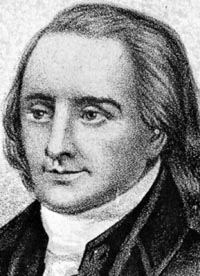
John Jay showed promise of an extraordinary life at a very young age indeed. He attended an exclusive boarding school in New Rochelle, New York at age eight, and proceeded to King's College (now Columbia University) at age Portrait of John Jayfourteen. He graduated with highest honors in 1764 and proceeded to the study of law under Benjamin Kissam. He was admitted to the Bar of New York in 1768. In early 1774 he was one of the most prominent members of the New York Committee of Correspondence.
In September of that year he attended the First Continental Congress as the second youngest member*, at age twenty eight. His authorship of the Address to the People of Great Britain, published by the first Continental Congress perhaps belied his resolute opinion for reconciliation with Gr. Britain. He retired from the Congress in 1776 rather than sign the Declaration of Independence. He became deeply involved in the development of a new state government for New York. In 1777 he attended the New York constitutional convention, and was selected to draft that constitution. He then served a the first Chief Justice of the state. He also served as a member of the state Council of Safety, acting as the sole council when the Legislature was not in session. He was again elected to the Continental Congress in 1778 and was voted president of that body upon arrival.
In 1779 Jay was appointed Minister to Spain in order to seek recognition of Colonial Independence, financial aid, and commercial treaties. In 1782 Jay, along with Adams, Franklin, and Laurens signed the treaty of peace with Great Britain. When he returned to Congress, he had already been appointed Secretary of Foreign Affairs.
In 1787 Jay wrote three of the articles now collectively called The Federalist, in which he, James Madison, and Alexander Hamilton argued effectively in support of the ratification of the new Federal Constitution. In 1789, Washington appointed him Chief Justice to the Supreme Court under the new federal constitution. In 1994 he was appointed an envoy extraordinary to Great Britain, in order to seek a resolution to continuing conflicts on the western border, and in commercial relations. The result of this was the Jay Treaty, which proved very unpopular with the public, but was nonetheless approved of by the Washington administration. Upon his return home Jay found that, in his absence, he had been elected Governor of New York. Fellow Federalist Alexander Hamilton had secured his election in an effort to strengthen the party in New York. Jay withstood a great deal of party maneuvering and political trickery, earning respect form his friends and enemies alike. He was a very popular Governor who fought for many political reforms including judicial reform, penal reform and the abolition of slavery. He undertook extensive road and canal projects to improve the economy of his state. He retired from public life in 1801. President John Adams tried to appoint him to the Supreme Court again that year, but owing to the illness of his wife, Jay declined the office. Jay died on May 17, 1829 having survived his wife and both of his partners in The Federalist. -Sources: EA . ©1996-2003 by LeftJustified Publiks. All rights reserved.


Thomas Jefferson ·1743—1826·
Virginia House of Burgesses, Representing Virginia at the Continental Congress
Born: April 13, 1743 in: Shadwell, Virginia
Education: William and Mary College (Lawyer)
Work: Admitted to Virginia bar, 1767; Elected to Virginia House of Burgesses, 1769; Delegate to the Continental Congress, 1775-76; Virginia House of Delegates, 1776-79; Elected Governor of Virginia, 1779, 1780; Dispatched to England to treat for peace with Gr. Britain, 1782; Associate Envoy to France, 1784; Minister to the French Court, 1785; Secretary of State, 1789; Established Democratic-Republican party, 1793; Vice President of the United States, 1796; President, 1801; Established University of Virginia, 1810. . .
Died: July 4, 1826.

Portrait of Thomas Jefferson More than a mere renaissance man, Jefferson may actually have been a new kind of man. He was fluent in five languages and able to read two others. He wrote, over the course of his life, over sixteen thousand letters. He was acquainted with nearly every influential person in America, and a great many in Europe as well. He was a lawyer, agronomist, musician, scientist, philosopher, author, architect, inventor, and statesman. Though he never set foot outside of the American continent before adulthood, he acquired an education the rivaled the finest to be attained in Europe. He was clearly the foremost American son of the Enlightenment.
Jefferson was born at Shadwell in Albemarle county, Virginia on April 13, 1773. He was tutored by the Reverend James Maury, a learned man, in the finest classical tradition. He began the study of Latin, Greek, and French at the age of nine. He attended William and Mary College in Williamsburg at sixteen years old, then continued his education in the Law under George Wythe, the first professor of law in America (who later would sign Jefferson's Declaration in 1776). Thomas Jefferson attended the House of Burgesses as a student in 1765 when he witnessed Patrick Henry's defiant stand against the Stamp Act. He gained the Virginia bar and began practice in 1769, and was elected to the House of Burgesses in 1769. It was there that his involvement in revolutionary politics began. He was never a very vocal member, but his writing, his quiet work in committee, and his ability to distill large volumes of information to essence, made him an invaluable member in any deliberative body.
In 1775 when a Virginia convention selected delegates to the Continental Congress, Jefferson was selected as an alternate. It was expected that Payton Randolph, (then Speaker of the Virginia House and president of the Continental Congress too,) would be recalled by the Royal Governor. This did happen and Jefferson went in his place. Thomas Jefferson had a theory about self governance and the rights of people who established habitat in new lands. Before attending the Congress in Philadelphia he codified these thoughts in an article called A Summary View of the Rights of British America. This paper he sent on ahead of him. He fell ill on the road and was delayed for several days. By the time he arrived, his paper had been published as a pamphlet and sent throughout the colonies & on to England where Edmund Burke, sympathetic to the colonial condition, had it reprinted and circulated widely. In 1776 Jefferson, then a member of the committee to draft a declaration of independence, was chosen by the committee to write the draft. This he did, with some minor corrections from James Madison and an embellishment from Franklin, the document was offered to the Congress on the first day of July. The congress modified it somewhat, abbreviating certain wording and removing points that were outside of general agreement. The Declaration was adopted on the Fourth of July. Jefferson returned to his home not long afterward. His wife and two of his children were very ill, he was tired of being remote from his home, and he was anxious about the development of a new government for his native state.
In June of 1779 he succeeded Patrick Henry as Governor of Virginia. The nation was still at war, and the southern colonies were under heavy attack. Jefferson's Governorship was clouded with hesitation. He himself concluded that the state would be better served by a military man. He declined re-election after his first term and was succeeded by General Nelson of Yorktown.
In 1791 he retired to Montecello, the estate he inherited, to write, work on improved agriculture, and attend his wife. It was during this time that he wrote Notes on the State of Virginia, a work that he never completed. Mary Jefferson died in September of 1782. This event threw Jefferson into a depression that, according to his eldest daughter he might never have recovered from. Except that Washington called on him in November of 1782 to again serve his country as Minister Plenipotentiary to negotiate peace with Gr. Britain. He accepted the post; however it was aborted when the peace was secured before he could sail from Philadelphia.
In 1784 Jefferson went to France as an associate Diplomat with Franklin and Adams. It was in that year that wrote an article establishing the standard weights, measures, and currency units for the Untied States. He succeeded Franklin as Minister to France the following year. When he returned home in 1789, he joined the Continental Congress for a while, and was then appointed Secretary of State under George Washington. This placed him in a very difficult position. The character of the executive was being established during the first few terms. Jefferson and many others were critical of the form it was taking under the first Federalist administration. Jefferson was sharply at odds with fellow cabinet members John Adams and Alexander Hamilton, both of whom he found to be too authoritarian and too quick to assume overwhelming power for the part of the executive. He resigned from the cabinet in 1793 and formed the Democrat-republican party. Heated competition continued. Jefferson ran for president in 1796, lost to John Adams, and, most uncomfortably, this made him vice president under a man whom he could no longer abide. After a single meeting, on the street, the two never communicated directly during the whole administration.
Jefferson again ran for the presidency in 1801 & this time he won. He served for two terms & he did ultimately play a deciding role in forming the character of the American Presidency. The 12th amendment to the Constitution changed the manner in which the vice president was selected, so as to prevent arch enemies from occupying the first and second positions of the executive. Jefferson also found the State of the Union address to be too magisterial when delivered in person. He performed one and afterwards delivered them, as required by the constitution, only in writing. He also undertook the Louisiana Purchase, extending the boundaries of the country and establishing the doctrine of manifest destiny.
Thomas Jefferson retired from office in 1781. He continued the private portion of his life's work, and sometime later re-engaged his dearest & longest friend James Madison, in the work of establishing the University of Virginia. In 1815 one of his projects, a Library of Congress, finally bore fruit, when he sold his own personal library to the congress as a basis for the collection. Shortly before his death in 1826, Jefferson told Madison that he wished to be remembered for two things only; as the Author of the Declaration of Independence, and as the founder of the University of Virginia. Jefferson died on the 4th of July, as the nation celebrated the fiftieth anniversary of his splendid Declaration. -Sources: PFG, EA, Nation. ©1996-2003 by LeftJustified Publiks. All rights reserved.


Francis Lightfoot Lee ·1734—1797·
Virginia House of Burgesses, Representing Virginia at the Continental Congress
Born: October 14, 1734 in: Westmoreland County, Virginia.
Education: Private, (Farmer)
Work: Member of the Virginia House of Burgesses 1758-75; Elected to Continental Congress, 1775-79, Member of Virginia Senate.
Died: January 11, 1797.

Francis Lightfoot Lee (brother of R.H. Lee) was born in Westmoreland, Virginia, on the fourteenth of October, 1734. He was educated at home by Doctor Craig, in the manner of an enlightened country gentleman. In 1765 he was elected to the Virginia House of Burgesses, where he served until 1775. He was a noted radical, on the side of Patrick Henry in opposing the Stamp Act. He Joined the group who called for a general congress and a Virginia Convention in 1774. He attended that convention and that year was sent to the first Continental Congress. He represented his state there until 1779, working on numerous committees. He retired from the Congress in 1779 and returned to his home. He served for a while in the Virginia Senate and then retired to private life. He died in 1797. -Sources: PFG, Signers. ©1996-2003 by LeftJustified Publiks. All rights reserved.


Richard Henry Lee ·1732—1794·
Virginia House of Burgesses, Representing Virginia at the Continental Congress
Born: January 20, 1732 in: Westmoreland county, Va.
Education: Private school at Wakefield, Yorkshire, England. (Farmer)
Work: Justice of the peace, 1757; Virginia House of Burgesses, 1757; Continental Congress, 1774; First US Senator for Virginia, 1789.
Died: June 19, 1794.

Richard Henry Lee (brother of F.L. Lee) was born to an aristocratic family at Stratford, in Westmoreland county, Virginia. He attended a private school in England, returning to Virginia in 1751. That being the era of the French and Indian War, Lee formed a militia troop of young men in his neighborhood, was elected the leader, and marched his troop to a council in Alexandria where General Braddock was preparing a campaign on the Ohio river. The young men were rebuffed by the General & returned home. In 1757 Lee was appointed Justice of the Peace, and was shortly thereafter elected to the Virginia House of Burgesses. He was amongst those radical members of the Burgesses who met at the Raleigh tavern when the house was dissolved by the Royal Governor. In 1774 he was elected to attend the first Continental Congress. He enjoyed many important committee appointments. Noted for his oratory skills, it was he who offered the Resolutions for Independence to the committee of the whole in 1776. He served in Congress through the course of the War, while also serving in the House of Burgesses. In 1783 he was selected as president of Congress.
Lee opposed the federal constitution, as he favored strong state rights. He was; however, elected the first State Senator from Virginia under the new federal government. He retired from that office to his home in Chantilly due to illness, and soon after died at the age of sixty three.-Sources: PFG, EA. ©1996-2003 by LeftJustified Publiks. All rights reserved.


Francis Lewis ·1713—1802·
Representing New York at the Continental Congress
Born: March, 1713 in: Llandaff, Wales
Education: Westminster (Merchant)
Work: Elected to the Continental Congress, 1775.
Died: December 31, 1802.

Born in Wales in 1713, Francis Lewis was partly educated in Scotland and then attended Westminster in England. He entered a mercantile house in London, and then came to New York to set up a business in 1734. He was taken prisoner and shipped to France while serving as a British mercantile agent in 1756. When he returned to America he became active in politics. He was elected to the Continental Congress in 1775, and served there for several years. He lost all of his property, on Long Island, New York, to the destruction of the Revolutionary war. He died on the thirty first of December, 1802. -Sources: PFG. ©1996-2003 by LeftJustified Publiks. All rights reserved.


Philip Livingston ·1716—1778·
Representing New York at the Continental Congress
Born: January 15, 1716 in: Albany, New York
Education: Graduate of Yale College (Merchant)
Work: Alderman, New York city; Delegate to the Albany Convention, 1754; Delegate to the Continental Congress, 1776; Later, State Senator in New York, Delegate to Federal Congress until 1778.
Died: June 12, 1778.

Philip Livingston was born in Albany, New York, on the fifteenth of January, 1716. He graduated at Yale College in 1737, and entered into mercantile business in the city of New York. He was a very successful businessman, and served his community as an alderman. In 1754 he attended the Colonial Convention at Albany. He was selected as a delegate to the Continental Congress in 1776, and was in strong favor of the Declaration of Independence. After the adoption of a new Constitution for New York State, he was elected to the state Senate. He was later elected to the US House of Representatives, but died suddenly while in attendance at York, Pennsylvania. -Sources: PFG. ©1996-2003 by LeftJustified Publiks. All rights reserved.


Robert Livingston ·1747—1813·
Representing New York at the Continental Congress
Born: 1747 in: New York, New York
Education: Graduated King's College (now Columbia University). (Lawyer)
Work: Member of Provincial Congress of New York, Continental Congress, 1776-1783; Chancellor of New York, 1783; Delegate to the New York ratifying Convention, 1788; Minister to the Court of Napoleon, 1801-(ca. 1805)
Died: February 26, 1813.

Robert Livingston was born in the city of New York in 1747. He was educated at King's (now Columbia) College, Portrait of Robert Livingstonwhere he was graduated in 1764. He studied law under William Smith, chief justice of New York, and became an eminent Lawyer. Livingston became politically active in the era of the Stamp Act Revolt, and was probably (along with his brother, William), involved with the Sons of Liberty in New York.
In 1776, as a member of the Provincial congress of New York, he was selected to attend the Continental Congress. He was one of the committee to draft the Declaration of Independence but was recalled by his state before he could sign it.
Livingston was appointed Secretary of Foreign Affairs (Secretary of State) soon after the Articles of Confederation were adopted. He served that post until 1783, when he was appointed Chancellor of the State of New York. He was an advocate for the Federal Constitution, and served as a delegate to the New York convention held at Poughkeepsie in 1788, to ratify it. On the 30th of April, 1789, Livingston administered the presidential oath of office to George Washington.
In 1801, President Jefferson appointed Robert Livingston resident minister at the court of Napoleon. It was he who negotiated the Louisiana Purchase from the French. He was also a patron of Robert Fulton, who refined the steam engine. Chancellor Livingston died on the 26th of February, 1813, at the age of sixty six. -Sources: EA. ©1996-2003 by LeftJustified Publiks. All rights reserved.


William G. Livingston ·1723—1790·
Representing New Jersey at the First Continental Congress
Born: November 30, 1723 in: Albany, New York
Education: Graduate of Yale. (Lawyer)
Work: Admitted to the Bar, 1748; Member of the New York Assembly, 1759-1761; Member of Essex County Committee of Correspondence, 1774; Delegate to the Continental Congress, 1774, 1776; Commander of the New Jersey Militia, 1776; Governor of New Jersey, 1776-1790; Delegate to the Constitutional Convention, 1787.
Died: 1790

William G. Livingston was born in Albany New York in 1723. Raised by his maternal grandmother, at age fourteen he left home to minister to the Mohawk Indians. He choose a career in law, attended Yale, and graduated 1741. He was admitted to the bar in 1748. He quickly became involved in political affairs. He was a party leader in the royalist days, and sat in the Colonial Assembly of New York from 1759 to 1761.
He took a wife and moved to Elizabethtown New Jersey in 1760. He built his estate there and began a lifelong interest in agriculture. In 1774 he was drawn into public service again, as a member of the Committee of Correspondence for his county. That year he was selected to attend the first Continental Congress. He continued in the Congress until September of 1776, when he was called to command the militia in defense of he state. Later that year he was elected the fist Governor of the State, an office to which he was reelected each year until his death in 1790.
Livingston also served as a delegate to the Constitutional Convention, and was active in securing its ratification in New Jersey afterward. Yale awarded him an honorary Doctorate of Law in 1788. He died in office at the age of sixty-seven. -Sources: .NARA ©1996-2003 by LeftJustified Publiks. All rights reserved.


Thomas Lynch Jr. ·1749—1779·
Representing South Carolina at the Continental Congress
Born: August 5, 1749 in: Winyah, South Carolina
Education: Graduated Cambridge University. (Lawyer)
Work: Captain of a South Carolina Regimental Company, 1775; Delegate to the Continental Congress, 1776.
Died: ca. 1779.

Thomas Lynch, Jr., was born in South Carolina on August 5, 1749. He received an education in England and graduated with honors at Cambridge. He studied law in London and then returned home in 1772. He was politically engaged as soon as he returned home, and was commissioned a company commander in the South Carolina regiment in 1775. Soon afterward he was elected to a seat in the Continental Congress. He fell ill shortly after signing the Declaration and retired from the Congress. At the close of 1776 he and his wife sailed for the West Indies. The ship disappeared & there is no record of his life after. -Sources: PFG, EA. ©1996-2003 by LeftJustified Publiks. All rights reserved.


Thomas M'Kean ·1734—1817·
Representing Delaware at the Continental Congress
Born: March. 19, 1734 in: New London, Pennsylvania
Education: Studied under Francis Allison (Lawyer)
Work: Deputy Attorney General to County Sussex 1756; Admitted to Bar of Pennsylvania Supreme Court, appointed Clerk of the Assembly of Delaware, 1757; Member of Delaware Assembly, 1762-79; Delegate to the Stamp Act Congress, 1765; Collector of Customs & Commissioner of Revenue at New Castle, 1771; Delegate to the Continental Congress, 1774-81; US Senator for Delaware, 1781-1783; President of Delaware, 1776; Chief Justice of Pennsylvania, 1777-97; Governor of Pennsylvania, 1799-1812.
Died: June 24, 1817.

Thomas M'Kean might just represent an ideal study of how far political engagement can be carried by one man. One can scarcely believe the number of concurrent offices and duties this man performed during the course of his long career. He served three states* and many more cities and county governments, often performing duties in two or more jurisdictions, even while engaged in federal office.
Born in New London, Pennsylvania, he studied law with his cousin David Finney, and then under the eminent Francis Allison. As a student he served as the clerk of the prothonotary Court of Common Pleas for the county of New Castle, Delaware. He was admitted to the bar in Delaware before the age of twenty one. In 1756 he was commissioned to his first political office, that of deputy Attorney General to county Sussex, in Pennsylvania. The following year he was admitted to the Bar of the Supreme Court of Pennsylvania, and at the same time appointed clerk of the Assembly of Delaware. In 1762 the Assembly appointed him a colleague, along with Caesar Rodney, charged with revising and printing the laws of the province of Delaware. Later that year he was elected a delegate to the Assembly, and was re-elected for seventeen years despite a six year residence outside the commonwealth, in Philadelphia. At the behest of the Assembly he served as a trustee of the provincial loan office from 1764 to 1772. In 1775 he was the delegate for Delaware at the Stamp Act Congress in New York. In 1771 he was appointed collector of customs and commissioner of revenue at New Castle. In 1772 to was chosen Speaker of the Assembly of Delaware. Beginning in 1774 he attended the Continental Congress where he served on the national council throughout the Revolutionary War. He also served on the committee to draw up the Articles of Confederation, was commissioned a colonel in the New Jersey militia, and served as President of the newly independent Delaware. In 1777, still serving in the Congress under the articles of Confederation, he was appointed Chief Justice of Pennsylvania, an office that he held for nearly twenty years. He was elected President of Congress in 1781. In 1787 he attended the ratifying convention for the new Federal Constitution in Pennsylvania. In 1789 he played a role in amending the constitution of Pennsylvania. He was elected Governor of Pennsylvania on the Federalist ticket in 1799. Political enemies tried to impeach him, but were unable to prove any wrong-doing. He filled that office by popular re-election for nine years, retiring in 1812. He died on June 24, 1817 at the age of eighty three.

*Pennsylvania, Delaware, and New Jersey. Pennsylvania and Delaware were not fully distinct colonies until 1776. From 1701 to 1776, both existed under a common executive, but had separate legislatures. -Sources: PFG, EA. ©1996-2003 by LeftJustified Publiks. All rights reserved.


Arthur Middleton ·1742—1787·
Representing South Carolina at the Continental Congress
Born: June 26, 1742 in: Charleston, South Carolina
Education: Graduate of Cambridge
Work: Charleston Council of Safety, 1775; Delegate to the Continental Congress, 1776.
Died: January 1, 1787.

Arthur Middleton was born in South Carolina in 1742. He was educated in England and graduated a Cambridge in 1763. He was elected to the Council of Safety at Charleston in 1775, and in 1776 was a delegate to the Continental Congress. He was captured by the British when Charleston was overrun 1780, and held prisoner at St. Augustine for a year. Most of his fortune was destroyed during the Revolution. He was engaged in politics until his death on the first of January, 1787. -Sources: PFG. ©1996-2003 by LeftJustified Publiks. All rights reserved.


Lewis Morris ·1726—1798·
Representing New York at the Continental Congress
Born: April 8, 1726 in: Morrisania (Bronx County), New York
Education: Graduate of Yale College (Farmer)
Work: Member of Provincial Legislature; Deputy to New York Convention, 1775; Delegate to the Continental Congress, 1775-77; County judge, Worchester, 1777; Served in New York Legislature, Member of the Board of Regents of the University of the State of New York.
Died: January 22, 1798.

Lewis Morris was born in New York in 1726. He inherited great wealth, most of which was lost during the war. He graduated at Yale College in 1746, and returned to the farm of his father, in Lower West Chester, near Harlem. When his father passed on he became engaged in politics. He served in the Provincial legislature shortly before the troubles with Gr. Britain began and before it was dissolved by the royal governor. Morris joined with the patriots when conflict began, siding , in many cases, against his wealthy neighbors. He convinced local politicians to send representatives to the re-formed Legislature in April of 1775. That congress appointed delegates to the second Continental Congress, and Morris was one. He served on committees for the defense of New York, one for provisioning colonial forces, and another for Indian affairs. These tasks carried him throughout New England in the first few years of the war. He also served as a brigadier-general in the New York militia and so was often torn between his duties in congress and those to the defense of his own colony. In 1777, he was succeeded in congress by his brother, Gouverneur Morris. He returned to his local duties, later served as a judge in Worchester, and served intermittently as a member of the upper house of the new legislature until 1790. All of the Morris property and nearly all of his wealth had been destroyed in the revolution. Lewis spend several years working to rebuild his farm. He also served on the first Board of Regents for the University of New York. He died in January 1798 at the age of seventy two. -Sources: PFG, Signers. ©1996-2003 by LeftJustified Publiks. All rights reserved.


Robert Morris ·1734—1806·
Representing Pennsylvania at the Continental Congress
Born: January 20, 1734 in: Lancashire, England
Education: Private & Apprenticeship (Merchant)
Work: Delegate to the Continental Congress, 1775, Appointed Special Commissioner of Finance, 1776; Author of the plan for a National Bank, 1781; Financial Agent of the United States, 1781; Delegate to the Pennsylvania Legislature, ca. 1783; Delegate to the Constitutional Convention, 1787; United States Senator, 1789-95; Appointed Secretary of the Treasury, 1789.
Died: May 9, 1806.

Robert Morris was a man of wealth and integrity in Philadelphia during the revolutionary period. though not a scholar or a soldier, he was to play an essential role in the success of the War against England, and in placing the new United Portrait of Robert MorrisStates on a firm footing in the world. Morris, almost single handed, saw to the financing of the Revolutionary War, and the establishment of the Bank of the United States after.
Born in England in 1733, he came to the Chesapeake Bay in 1744 and attended school in Philadelphia. Young Robert, who seemed ill suited to formal education and too quick for his teacher in any case, was soon apprenticed to the counting room of Charles Willing at the age of sixteen. Two years later his employer died and Morris entered a partnership with the gentleman's son. In the succeeding thirty nine years that business flourished, and Robert Morris' wealth and reputation were secured. Being an importer, the business was hit hard by the Stamp Act and the colonial revolt against it. Morris and his partner choose the side of the colonials and Robert engaged in the movements against British rule.
Elected to the Continental Congress in 1775, he participated on many of the committees involved in raising capital and provisions for the Continental Army. Early in 1776, he was given a special commission by congress, with authority to negotiate bills of exchange for, and to solicit money by other means for the operation of the war. One of the most successful such devices were the lotteries. In late 1776, with the Continental Army in a state of severe deprivation because of a shortage of capital and the failure of several of the colonies in paying for the war, Morris loaned $10,000 of his own money to the government. This money provisioned the desperate troops a Valley Forge, who went on to win the Battle of Trenton and turn the course of the war. Throughout the war he personally underwrote the operations of privateers, ships that ran the British Blockades at great risk and thus brought needed supplies and capitol into the colonies.
In 1781 he devised a plan for a National Bank and submitted it to Congress. It was approved and became The Bank of North America, an institution that brought stability to the colonial economy, facilitated continued finance of the War effort, and would ultimately establish the credit of the United States with the nations of Europe. Morris was immediately appointed Financial Agent (Secretary of Treasury) of the United States, in order to direct the operation of the new bank.
Following the war, he served in the Pennsylvania Legislature. He was also a delegate to the Constitutional Convention in 1787, and thereafter an advocate for the new constitution. He was then sent as a Senator for Pennsylvania when that constitution was ratified. In 1789, President Gorge Washington appointed Morris Secretary of the Treasury, but he declined the office and suggested Alexander Hamilton instead. Morris completed his office as Senator and then retired from public service. He never recovered the wealth that he enjoyed before the revolution. What was left of his fortune was soon lost to land speculation in the western part of New York state. He died in 1806, in relative poverty, at the age of seventy three. -Sources: PFG, EA. ©1996-2003 by LeftJustified Publiks. All rights reserved.


John Morton ·1724—1777·
Representing Pennsylvania at the Continental Congress.
Born: 1724 in: Ridley, Pennsylvania
Education: Informal (Judge)
Work: Elected to Provincial Assembly, 1756-1775; Delegate to the Stamp Act Congress, 1765; President of the Provincial Assembly, 1775; Offices in Pennsylvania: Justice of the Peace, High Sheriff, Presiding Judge of the General Court and the Court of Common Pleas, Associate Judge of the Supreme Court of Pennsylvania; Elected to Continental Congress, 1774-77.
Died: April, 1777.

John Morton was born in Delaware in 1724. In his youth he was noted for his quick intelligence and his habit of hard work. His stepfather, a well educated surveyor from England, gave him a sound education in practical matters and in surveying. In 1756 Morton was elected to the Provincial Assembly, and was elected president of the Assembly in 1775. He attended the Stamp Act Congress in 1765. He filled numerous civil offices in Pennsylvania, including Justice of the Peace, High Sheriff, Presiding Judge of the General Court and the Court of Common Pleas. In 1774 he was appointed Associate Judge of the Supreme Court of Pennsylvania. That year he was elected to the Continental Congress where he was a member of several committees and chairman of the committee which reported the Articles of Confederation. He died soon after that report was presented to Congress, at the age of fifty three. -Sources: PFG, Signers. ©1996-2003 by LeftJustified Publiks. All rights reserved.


Thomas Nelson Jr. ·1738—1789·
Virginia House of Burgesses, Representing Virginia at the Continental Congress
Born: December 26, 1738 in: Yorktown, Virginia
Education: Private, in England. Graduate of Cambridge. (Farmer)
Work: Member of the House of Burgesses, 1774; Virginia provincial Convention, 1775; Officer & Commander of the Virginia Militia, 1775...; Delegate to the Continental Congress, 1775-77, 1779; Elected Governor of Virginia, 1781.
Died: January 4, 1789.

Thomas Nelson Jr. was born into the aristocratic society of Virginia in December of 1738. Like most of the southern Gentleman of his day, he gained a private education in England, culminating in a degree from Cambridge. He returned in 1761 and soon became involved in service to his colony and his country. Elected to the House of Burgesses in 1774, he was one of eighty nine who convened at the Raleigh tavern when that house was dissolved by the royal Governor (see Virginia Association). He was a member of the Virginia provincial convention in 1775, and there he undertook the creation of the Virginia Militia. He then assumed duty as its first Commander. Shortly thereafter he was elected to the Continental Congress. Nelson began suffering health problems in 1777 and thought best to retire to his native state. He resumed his military service, much to the benefit of both Virginia and his health. He was reelected to Congress in 1779 but his health again declined and he returned to Virginia several months later.
Once again he resumed service, as commanding General of the Lower Virginia Militia, at a time when British forces began aggressive campaigns against the southern colonies. In 1781, Thomas Jefferson declined reelection as Governor due to his inability to serve the needs of a state under siege. General Nelson succeeded Jefferson and served as both Civil Governor and Commander in chief of the Virginia Militia. Under his command Virginia, both civil and Military, became a force to contend with. Both the Continental Army and French forces utilized the skills of the Virginia units in the Siege of Yorktown in the autumn of 1781.
Finally overcome by illness in October of that year, General Nelson retired from public service. He died at his residence in Yorktown in 1789 at the age of fifty three. -Sources: PFG, EA. ©1996-2003 by LeftJustified Publiks. All rights reserved.


Robert Carter Nicholas ·1728—1780·
Virginia House of Burgesses
Born: 1728
Education: Graduate, College of William and Mary (Lawyer)
Work: Representative to the Virginia House of Burgesses, 1755 to 1766; Treasurer to Virginia, 1766; Appointed to the Virginia Court of Chancery, 1778.
Died: 1780

Robert Carter Nicholas was one of Virginia's leading conservative patriots. As a member of the House of Burgesses he helped draft resolutions against the proposed Stamp Act in 1764. Nicholas was not amongst the group of radical members, lead by Patrick Henry, who would fan the flames of revolt against Britain. He did; however, introduce the resolution of May 23, 1774, setting aside June 1 as a day of fasting, humiliation, and prayer in sympathy with embargoed Boston. He is also remembered for opposing Henry's resolution, in 1775, for raising a 10,000 man militia "for the duration." Though Nicholas was never an advocate of independence from Britain, his legal skill and personal integrity earned him the greatest respect from his contemporaries. -Sources: HA. ©1996-2003 by LeftJustified Publiks. All rights reserved.


Lord North ·1732—1792·
Prime Minister of Great Britain, January 1770—March 1782.
Born: April 13, 1732.
Education: Attended Eton and Trinity College.
Work: Elected to Parliament, 1756; Served on the Treasury Board, 1759; as Joint Paymaster-General, 1765; as a member of the Privy Council, 1766; as Chancellor of the Exchequer, 1767; as Prime Minister, 1770.
Died: August 5, 1792.

North was admired for his deep loud voice, his oratory skills, and his quick wit in negotiation and debate. North's strong suit was in financial & economic matters. He nearly recovered Britain from a crushing national debt following the Seven Years' War. However, the War of Independence overtook him. He resigned in March of 1782. He died on 5 August, 1792; forever remembered as the minister who lost America. -Sources: FRR. ©1996-2003 by LeftJustified Publiks. All rights reserved.


Copyright ©1996-2003 by LeftJustified Publiks. All Rights reserved.