
This document supports Account of a Declaration, a service of the point.B Library.
Copyright ©1996-2003 by LeftJustified Publiks. All Rights reserved.


George Taylor ·1716—1781·
Representing Pennsylvania at the Continental Congress
Born: circa 1716 in: Ireland
Education: Ironmaster
Work: Elected to the provincial Assembly, 1764-69; Member of the Committee of Correspondence, Committee of Safety, 1773-76; Elected to Continental Congress, 1775-77.
Died: February 23, 1781.

Little is know about George Taylor. He was a working man and little concerned with politics, though he acted in service to his nation when called. He was born in Northern Ireland and emigrated to America in his early twenties. He was an Ironmaster at the Warwick Furnace and Coventry Forge. Later he and a partner leased an iron furnace in Bucks County. Iron production was his principle concern all of his life.
Taylor was elected to the provincial assembly for Pennsylvania in 1764, and was reelected for five consecutive years. He was a member of the committee to draft the instructions of Pennsylvania delegates to the first Continental Congress, a member of the Committee of Correspondence, and of the Committee of Safety. In 1775 he was appointed to replace a member of the Pennsylvania delegation who refused to support Independence. He arrived too late to vote, but did sign the Declaration. He served Congress through 1777. He was then elected to the new Supreme Council of his state, but served for only six weeks, apparently due to illness. There is no record of any public service afterward. He died in 1781 at the age of sixty-five. -Sources: PFG, Signers. ©1996-2003 by LeftJustified Publiks. All rights reserved.


Matthew Thornton ·1714—1803·
Representing New Hampshire at the Continental Congress
Born: 1714 in: Ireland
Education: Physician
Work: Appointed surgeon to the New Hampshire Troops, 1745; Member of the Provincial Assembly, 1758-62, ??-1775; Colonel of the Londonderry Militia, Londonderry Town Selectman, 1763-75; Londonderry Committee of Safety, 1775, 76; Speaker of the New Hampshire House of Representatives, Associate Justice of the Superior Court, Delegate to the Continental Congress, 1776.
Died: June 24, 1803.

Matthew Thornton was born in Ireland in 1714. His parents emigrated to America when he was three. They first settled at Wiscasset, in Maine, but soon went to Worcester, Massachusetts, where Mathew received an academic education. He became a physician, and in 1745 was appointed surgeon to the New Hampshire troops in the expedition against Louisburg. He later held royal commissions as justice of the peace and colonel of militia. His medical practice was very successful and he acquired much land, becoming a leading member of the community in Londonderry. There he held many local offices while also representing Londonderry at the Provincial Assembly. Thornton eventually became President of that assembly. As a member of a local committee of Safety in 1775, he was asked to draft a plan of government for New Hampshire after dissolution of the royal government. His plan was adopted immediately and became the first constitution for that state (and was in fact the first new state constitution after the start of hostilities with Britain).
Thornton was then selected as the first President of the New Hampshire House of Representatives, and as a justice to the Superior Court, under the new constitution. He was also sent to the Continental Congress—too late to participate in the debates over Independence, but just in time to sign the Declaration on behalf of New Hampshire. He was selected to attend Congress again in 1777, but declined to attend due to poor health. For the rest of his life, Thornton attended to State duties. He also wrote political essays for the newspapers. He died at the age of eighty-nine, while on a visit to his daughter in Newburyport, Massachusetts, in 1803. -Sources: PFG, Signers. ©1996-2003 by LeftJustified Publiks. All rights reserved.


George Walton ·1741—1804·
Representing Georgia at the Continental Congress
Born: 1741 in: Prince Edward County, Va.
Education: Informal, perhaps self-taught (Lawyer, Judge)
Work: Admitted to the Bar, 1774; Member, Secretary, Provincial Congress of Georgia, 1776; Member, Georgia Committee of Safety, 1776; Elected to the Continental Congress, 1776, 77, 1780, 81; Colonel of the First Georgia Militia, 1778; Governor of Georgia, 1779; Chief Justice of Georgia, 1783-89; Presidential Elector, Governor of Georgia, 1789; Superior Court Judge, 1789-98, US. Senator, 1795.
Died: February 2, 1804.

George Walton was born in Frederick county, Virginia, in 1741. His parents died soon after, and he was adopted by an Uncle who apprenticed him as a carpenter. Little else is know about his early years. He appeared again in 1769 when he moved to Savannah and began to study Law. He was admitted to the Bar in 1774. Deeply involved with the patriot movement in Georgia, he would ultimately serve an important role in the development of the state.
At the formation of the Georgia provincial Congress, Walton was elected Secretary, and made President of the Council of Safety. In 1776 he was elected to the Continental Congress, where he signed the Declaration of Independence. He spent many of the following years engaged in the defense of his state, and in a messy political battle with Button Gwinnett, another signer from Georgia. In 1778 Walton was commissioned a Colonel of the First Regiment of the Georgia Militia. He was injured in Battle and taken prisoner. He gained his freedom in 1779 through a prisoner exchange and was soon after elected Governor of Georgia, an office he held for only two months. Political conflict colored all of Walton's career. He was allied with General Lachlan McIntosh in a fierce struggle against Gwinnett for political dominance of the state. Walton was dispatched from office on several occasions, indicted for alleged criminal activities on others, in an interminable battle between two factions of the patriot movement in Georgia.
He was returned to congress in 1780 and stayed through 1781. He remained in Philadelphia until 1783. That year he was censured by the legislature for his involvement in a duel which led to the death Gwinnett by the hand of his rival, commissioned to treat with the Cherokee nation in Tennessee, and appointed Chief Justice of his state. In 1789 he served in the college of Electors and again elected Governor. The government was reorganized under an new constitution in November of that year, at which time Walton stepped down. He was immediately appointed a superior court judge. In 1795 he was sent to fill an unfulfilled term in the US Senate. He was not reelected. He then retired to farming. He died in Augusta in 1804 at the age of sixty-four. -Sources: Prof, Signers. ©1996-2003 by LeftJustified Publiks. All rights reserved.


William Whipple ·1730—1785·
Representing New Hampshire at the Continental Congress
Born: January 14, 1730 in: Kittery, Maine
Education: Common School. (Merchant, Soldier, Judge)
Work: Elected to Provincial Congress, 1775, 76; Member of state Council, Committee of Safety, 1776; Elected to Continental Congress, 1776-79; Commissioned Brigadier General of the New Hampshire Militia, 1777- ca. 1781; Appointed Associate Judge to the Superior Court, 1782.
Died: November 28, 1785.

William Whipple was born at Kittery Maine, in 1730. He was educated at a common school until his early teens, when he went off to sea to find his fortune. He was an able seaman, earning the position of Ship's Master by the age of twenty-one. He worked hard and amassed a great deal of money. In 1759 he landed in Portsmouth and, in partnership with his brother, established himself as a merchant. Calls to public duty began almost immediately. He was elected to several local offices and was involved in the Patriot movement.
In 1775 he was elected to represent his town at the provincial congress. The following year New Hampshire dissolved the Royal government and reorganized with a House of Representatives and an Executive Council. Whipple was made a Council member, a member of the Committee of Safety, and was promptly elected to the Continental Congress. He served there through 1779, though he took much leave for military affairs. In 1777 he was made Brigadier General of the New Hampshire Militia. General Whipple lead men in the successful expedition against General Burgoyne at the battles of Stillwater and Saratoga.
After the war Whipple was appointed an associate justice of the Superior Court of New Hampshire. He suffered from a heart ailment for several years & he died, fainting from atop his horse while traveling his court circuit, in November of 1785. -Sources: PFG, Signers. ©1996-2003 by LeftJustified Publiks. All rights reserved.


William Williams ·1731—1811·
Representing Connecticut at the continental Congress
Born: April 23, 1731 in: Lebanon, Conn.
Education: Graduate of Harvard (Merchant)
Work: Town Clerk, Selectman, Provincial Representative, Council to the Legislature. Elected State Legislator, delegate to colonial conferences, 1775; Elected to Continental Congress, 1776-77; Delegate to the Connecticut convention to ratify the federal Constitution, 1785; Judge of the Windham County Courthouse.
Died: August 2, 1811.

His biography notes that William Williams was a successful merchant, but it is difficult to imagine when he found the time. Born in 1731, he attained a common school education. He attended Harvard and graduated in 1751. He then studied theology with his father, Pastor of the First Congregational Church in Lebanon. Four years later, he joined his father's cousin in the French and Indian War at Lake George. When he returned, he established himself in Lebanon as a merchant, and also took a job as town clerk. He held that position for forty-four years. He was a Selectman for twenty-five years, served the provincial and later state Legislature for nearly forty years—during which time he was councilor, member, and Speaker of the House.
He was elected to the Continental Congress in 1776. He voted for Independence, signed the Declaration, and was then appointed a member of the committee to frame the Articles of Confederation. In 1777 he was appointed to the Board of War. After the war, he attended the Hartford convention, where Connecticut ratified the Federal Constitution. Williams spent his remaining years as a County Court judge. He died in 1811 at the age of eighty. -Sources: PFG, Signers. ©1996-2003 by LeftJustified Publiks. All rights reserved.


James Wilson ·1742—1798·
Representative for Pennsylvania to the Continental Congress.
Born: September 14, 1742.
Education: Attended the Universities of St. Andrews, Glasgow, and Edinburgh; College of Philadelphia. Honorary M.A. from Philadelphia College, studied Law with John Dickinson. (Lawyer, Judge)
Work: Admitted to the Bar, 1767; Member of the Pennsylvania provincial meeting, appointed to a Committee of Correspondence, 1774; Elected to Provincial Congress, 1775; Commissioned Colonel of the Fourth Cumberland County Battalion, 1775; Elected to the Continental Congress, 1775-77, 1785-87; Director of the Bank of North America, 1781; Member of the Constitutional Convention, 1784; Associate Justice to the US. Supreme Court, 1789-1798.
Died: August 28, 1798.

James Wilson was born in Scotland in 1742. He attended a surprising number of Universities there, and never attained a degree. He emigrated to America in 1766, carrying a number of valuable letters of Introduction with him. Through these connections he began tutoring and then teaching at the Philadelphia College. He petitioned there for a degree and was awarded an honorary Master of Arts several months later.
The most popular career field in those days was the law. Wilson managed to secure studies at the office of John Dickinson a short time later. After two years of study he attained the bar in Philadelphia, and the following year (1767) set up his own practice in Reading. His office was very successful and he managed to earn a small fortune in a few short years. At that point he had bought a small farm near Carlisle, was handling cases in eight local Counties, and lecturing on English Literature at the College of Philadelphia. It was also during this period that he began a life-long fascination with land speculation.
In 1774 Wilson attended a provincial meeting, as a representative of Carlisle, and was elected a member of the local Committee of Correspondence. He wrote a pamphlet titled "Considerations on the Nature and Extent of the Legislative Authority of the British Parliament." In it, he argued that the Parliament had no authority to pass laws for the colonies. It was published, and later found its way to the Continental Congress, where it was widely read and commented on. In 1775 he was elected to the Continental Congress, where he assumed a position with the most radical members-a demand for separation from Britain. James Wilson's powers of oration, the passion of his delivery and the logic he employed in debate, were commented on favorably by many members of the Congress. He was; however, in a bind. Pennsylvania was divided on the issue of separation, and Wilson refused to vote against the will of his constituents. Many members felt that it was hypocritical to have argued so forcefully and so long for Independence, only to vote against it when the occasion came. Wilson, with the support of three other members who were sympathetic to his position, managed a delay of three weeks, so that he could consult with people back home. When the vote came, he was able to affirm Pennsylvania's wish for Independence.
Following the Declaration, Wilson's attention turned back to his state, where a new constitution was proposed. He was strongly opposed to its form, and argued against it at every opportunity. This placed his office in jeopardy. He was recalled from Congress for about two weeks in 1777 but no one would take his place, so he was restored until the end of his term. Wilson did not return home following his term. He stayed in Annapolis through the winter, settled in Philadelphia. He resumed some of his former law practice there, only now he consulted to corporations. He was a leader in the Democratic-republican party. He also resumed his activities in speculation, including profiteering. He borrowed heavily and gambled aggressively. These activities eventually caught up with him in two ways. First, he acquired a great deal of debt & for this he was very nearly arrested on several occasions. Second, he was repeatedly accused of "engrossing," the practice of hoarding goods against the public need in order to drive up prices. During a food shortage in 1779, he and his property were attacked during riots in Philadelphia. He was rescued by a law enforcement troop, but had to hide for some time.
In 1779 Wilson was appointed by France to serve as its US advocate general for maritime & commercial enterprises. He was elected to Congress again in 1782, where he worked closely with Robert Morris on financial matters of state. In 1781, Wilson was appointed a director of the original Bank of North America. In 1884, he was appointed to the Constitutional Convention in Philadelphia. Following ratification of the new Constitution, he searched for an appointment to the Federal government. He appealed directly to Washington, and was appointed an Associate Justice in 1789.
The remainder of his life was miserable. His wife had died in 1786. In 1792 he returned again to speculation in land New York and Pennsylvania. His finances were completely destroyed within a short time & he spent some time in a debtors prison (while still serving on the Supreme Court!). By 1798 Wilson was destroyed as a man as well. He complained of great mental fatigue and an inability to work any longer. He died while visiting a friend in North Carolina that same year. -Sources: PFG, Signers. ©1996-2003 by LeftJustified Publiks. All rights reserved.


John Witherspoon ·1723—1794·
Representing New Jersey at the Continental Congress
Born: February 15, 1723 in: Gifford, Scotland
Education: Master of Arts, University of Edinburgh; Doctorate of Divinity, University of St. Andrews. (Clergyman, Author, Educator)
Work: President of College of New Jersey, 1768-1792; Delegate to the Continental Congress, 1776-1782; Twice elected to State Legislature of New Jersey.
Died: November 15, 1794.

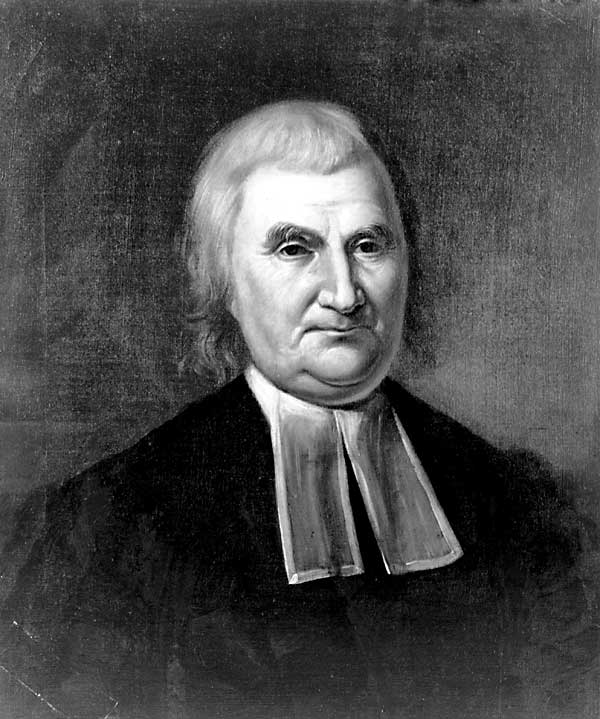
John Witherspoon brought some impressive credentials and a measure of public acclaim with him when he joined the colonies in 1768, as president of the College of New Jersey (now Princeton).
Born in 1723, he received the finest education available to a bright young gentleman of that era. John attended the preparatory school in Haddington Scotland. He proceeded to Edinburgh where he attained a Master of Arts, then to four years of divinity school. At this point he was twenty. In 1743 he became a Presbyterian Minister at a parish in Beith, where he married, wrote three noted works on theology. He was later awarded a Doctorate of Divinity from the University of St. Andrews, in recognition of his theological skills. It was only through a protracted effort on the part of several eminent Americans, including Richard Stockton and Benjamin Rush, that the colonies were able to acquire his service. In colonial American, the best educated men were often found in the clergy. The College of New Jersey needed a first rate scholar to serve as its first president. Witherspoon was at first unable to accept the offer, due to his wife's great fear of crossing the sea. She later had second thoughts, and a visit from the charming Dr. Rush secured the deal. He emigrated to New Jersey in 1768.
Dr. Witherspoon enjoyed great success at the College of New Jersey. He turned it into a very successful institution, and was a very popular man as a result. He also wrote frequent essays on subjects of interest to the colonies. While he at first abstained from political concerns, he came to support the revolutionary cause, accepting appointment to the committees of correspondence and safety in early 1776. Later that year he was elected to the Continental Congress in time to vote for R. H. Lee's Resolution for Independence. He voted in favor, and shortly after voted for the Declaration of Independence. He made a notable comment on that occasion; in reply to another member who argued that the country was not yet ripe for such a declaration, that in his opinion it "was not only ripe for the measure, but in danger of rotting for the want of it." Whitherspoon was a very active member of congress, serving on more than a hundred committees through his tenure and debating frequently on the floor.
In November, 1776, he shut down and then evacuated the College of New Jersey at the approach of British forces. The British occupied the area and did much damage to the college, nearly destroyed it. Following the war, Witherspoon devoted his life to rebuilding the College. He also served twice in the state legislature. In the last years of life he suffered injuries, first to one eye then the other, becoming totally blind two years before his death. He died on his farm, "Tusculum," just outside of Princeton in November of 1794, a man much honored & beloved by his adopted countrymen. -Sources: EA, Signers. ©1996-2003 by LeftJustified Publiks. All rights reserved.


Oliver Wolcott ·1726—1797·
Representing Connecticut at the Continental Congress
Born: December 1, 1726 in: Windsor, Connecticut
Education: Graduate of Yale. (Soldier, Sheriff, Judge)
Work: Sheriff of Litchfield County, ca. 1751-1775; Judge, 1750s, 60s; Militia leader, 1771-1774; Commissioner of Indian Affairs, 1775, 1784-89; Delegate to the Continental Congress, 1775-76, 1778-84; Brigadier General of the Connecticut Militia, 1776… ; Lt. Governor of Connecticut, 1786-96; Governor, 1796-97.
Died: December 1, 1797.

Oliver Wolcott was the youngest of fourteen children of then Royal Governor Roger Wolcott. Oliver attended Yale, a distinguished student, graduating in 1747. Even before graduating, he was commissioned by Governor Clinton of New York to raise a volunteer militia to assist in the French and Indian War. He did this, graduated Yale, and proceeded as Captain with his volunteer company to serve the crown on the northern frontier.
At the close of the war. Wolcott studied medicine with his brother for a while. As things took their course, he was appointed sheriff of a new Litchfield County, Connecticut, around 1751. He served as sheriff for more than twenty years. In 1771 he rejoined the Militia as revolutionary tensions grew. He was made a Major, and later a Colonel in the Connecticut Militia. Before the course of the war would end, he would become Brigadier General of the entire Connecticut force, under command of the Continental Armies.
In 1774 the Continental Congress appointed him a Commissioner of Indian Affairs in order to secure a treaty at the council at Albany. He was elected to the Congress in 1775. Wolcott was not very active in Congress. He was more concerned with military affairs & did suffer a bought with serious illness in 1776. He was not present for the occasion of the Declaration, but signed it some time later. He spent all of the time between 1776 and 1778 engaged in military affairs. In 1778 he was again elected to the congress, where he served until 1784.
He then retired, although the congress called him twice more to serve as an Indian Commissioner. Wolcott was much revered in his native state. Yale honored him with a second degree, he was elected president of the Connecticut Society of Arts and Sciences, and in 1786 he was elected Lieutenant Governor of his state. He assumed the Governorship when Samuel Huntington died in January of 1796, and was popularly elected to the post at the following election. He died in that office in 1797 at the age of seventy-one. -Sources: PFG, Signers. ©1996-2003 by LeftJustified Publiks. All rights reserved.


George Wythe ·1726—1806·
Representing Virginia at the Continental Congress
Born: 1726 in: Elizabeth City Co. (Hampton), Va.
Education: Informal, Law Studies. (Lawyer, Educator)
Work: Admitted to the Bar in Virginia, 1746; Clerk of the committee on Privileges & Elections of the House of Burgesses, 1747; Attorney General of Virginia, 1753; Member of the House of Burgesses; 1755-65; Member of the Board of Visitors, William & Mary, 1761; Professor of Law, Wm. & Mary, 1769-1789; Elected to Continental Congress, 1775-76; Speaker of the Virginia House, 1777-78; Judge of the Chancery Court of Virginia, 1789-1806
Died: June 8, 1806.

George Wythe was one of the very most distinguished men of his age, yet due to his modesty and quite dignity, we learn little about him from the history books. He was born in Elizabeth County Virginia, in 1726, of a wealthy agricultural family. His father died when George was three, but his mother, who was extraordinarily well educated for a woman of that day, tutored him in the classics in a manner that would take him far indeed. His mother died when he was still a teenager and his oldest brother, who took no interest in George, inherited the family property. George entered the college of William and Mary but was unable to keep up with the fees. He dropped out and then managed to secure a study of law at the office of a Stephen Dewey. His studies were so successful that he was admitted to the bar in Spottsylvania County in 1746, at the age of twenty.
Everyone who came into contact with him was impressed. He was appointed clerk to the Committee which formed the rules of conduct & elections in the House of Burgesses in 1746. In 1753 the Royal Governor of Virginia made him Attorney General, to fill the shoes of Peyton Randolph while he traveled to England. In 1755 Wythe was elected to represent Williamsburg at the House of Burgesses. At that time, his oldest brother died, and he inherited the family farm. Wythe served in the House of Burgesses until it was dissolved, on the eve of the revolution.
His most valuable contribution to the new nation was his involvement in education. This began in 1761 when he was elected to the Board of Visitors at the College of William & Mary. Eight years later the man who could never gain a degree for want of the money to do it with, became America's first Professor of Law. His students included Thomas Jefferson, Henry Clay, James Monroe, John Marshal, and several dozen other distinguished public servants. He taught for twenty years & admitted to no greater love than that of forming young minds.
In 1775 Wythe was elected to attend the Continental Congress. He served for two years, voted in favor of the Resolution, and for the Declaration. In 1776 he was called back to Virginia in order to help form the new government. He was elected Speaker of the Virginia House of Delegates in 1777. The following year he was made one of the three Chancellors of the State of Virginia, a post that he served in for the rest of his life. George Wythe was revered as a man on great honor & integrity. He was a republican in all things, and a quiet abolitionist. He freed his slaves & made provisions for their support until they could earn a living for themselves. This ended in tragedy—and that tragedy would cost Wythe his own life. A young member of his family, on discovering that Wythe had conditionally willed part of the family property to his slaves, decided to enlarge his own share by poisoning them with arsenic. He incidentally murdered George Wythe in the process. Wythe died on June 8th, 1806 at the age of eighty.-Sources:PFG, Signers. ©1996-2003 by LeftJustified Publiks. All rights reserved.


Copyright ©1996-2003 by LeftJustified Publiks. All Rights reserved.